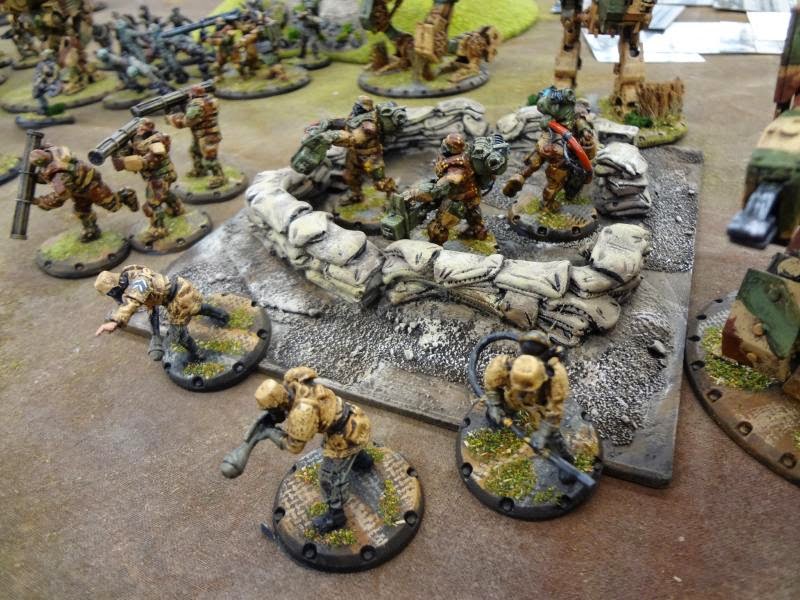
H-Hour is the working title of Kurt's WWI rules, which have been in the works for at least 5 years. Recently Kurt retired and suddenly found time to step up his 1914 campaign in the Ardennes.
Yesterdays battle pitted Eli and John's German Divisions against Jim's French Division. I was happy not to be in that sector when the barrage began. Surprising enough the French held the bridges in that sector but that Division was pretty much wrecked.
Here is Kurt's write up.
I'm the game designer. (Thanks for posting Mike).
It's
hex based, which allows the easy calculation of area effect against
targets in the hex. We apply all the firepower against each hex to every
stand of troops in it. One can spread out to save on losses, but
winning close combat requires mass. So as an attacker masses to charge
an enemy strong point, they begin to draw more effective fire.
The rules are still being play tested so I'm not ready to send them out yet.
Anyways,
in our campaign, we are playing an alternate Lorraine 1914 Campaign.
Von Moltke has denied the Ersatz Divisions to the German 6th Army, so
the sides are close in strength.
In the game shown, the French
30th Division (XV Corps) had approached the rail junction at Bensdorf,
southeast of Metz. Crown Prince Rupprecht (German 6th Army Commander)
had railed in three battalions of 21cm and two battalions of 15cm guns
to the XXI Corps, and had them counterattack. General Espinasse,
commander of the French XVI Corps had suspected such a move and dug in,
in response to orders to attack Bensdorf "if practicable."
The
opening barrage was very effective, the French being baited into giving
their partial-defilade gun positions away by a weak opening before
unleashing the full weight of fire. Half the French artillery was
destroyed and the other half silenced. The whole front line of French
positions were suppressed.
The Germans surged forward and over
ran the front line positions easily, taking many prisoners and capturing
the 30th Divisions HQ. A brave surrounded French battalion at the
village of Guebling was the only real resistance keeping the Germans
from sweeping down to the town of Dieuze and cutting off large numbers
of French. They were wiped out after 2 hours resistance, but the time
they bought allowed the French to rally many survivors.
The
attack bogged down shortly thereafter at a low ridge. The German guns
were at their range limit and at this distance couldn't distinguish
friend from foe. Couriers failed to reach the guns in a timely manner,
and sometimes German artillery fire held up their infantry advance.
So
the Germans held all artillery fire, and tried to cross the low ridge
that separated them from the surviving French with rifle battalions and a
few MG. The surviving French artillery had recovered and were firing at
1000m from behind the ridge, in a reverse slope position which was safe
from counter battery. This fire ended the advance.
A final
German infantry attack, again with no artillery support, through the
Forests of Koecking and de Bride that attempted to outflank the French
ran into large numbers of dug in French armed with MG. That failed too.
So German infantry losses which were initially negligible rose
rapidly, until they had taken about 25% losses and called it a day.
The
French 30th Division was wrecked, as well as their Corps artillery.
They had taken over 50% losses (many of these were POW). The surviving
should have routed but their die rolls were exceptionally good.
So that's what you are looking at.


 |
| View from German Artillery |
|